

Short answer
Confessing to a priest is following the apostolic tradition of the ministry of reconciliation.
Full answer
Confession of sins to a priest is solidly rooted in Scripture and Church tradition. After His resurrection, Jesus granted the apostles the power to forgive sins, as we see in John 20:22-23: "He breathed on them and said, ‘Receive the Holy Spirit. If you forgive anyone’s sins, they are forgiven; if you retain them, they are retained.’” This clearly shows that Jesus instituted the sacrament of Reconciliation, entrusting the apostles with the mission of forgiving sins in His name.
Furthermore, in Matthew 16:19 and Matthew 18:18, Jesus gives the apostles the power to “bind and loose,” that is, the authority to forgive or retain sins. This power was passed down to the successors of the apostles, the bishops and priests, who act as ministers of reconciliation, as taught by Saint Paul in 2 Corinthians 5:18-20: “God reconciled us to Himself through Christ and gave us the ministry of reconciliation.”
In James 5:16, we are instructed to “confess our sins to one another,” highlighting the role of priests in prayer and intercession for the spiritual healing of the sinner. This is the basis for the practice of sacramental confession, where the priest acts in the name of Christ and the Church.
The authority to forgive or retain sins, mentioned again in John 20:23, makes it clear that this act is a necessary sacrament to restore communion with God and the community. The forgiveness of sins is not merely a recommendation but an integral part of the apostolic ministry.
Luke 5:24 and Luke 24:47 show that Christ has the power to forgive sins and entrusted this authority to the apostles so that reconciliation could be proclaimed in His name. Thus, confessing to a priest is to follow the will of Christ and seek reconciliation with God.
Finally, in Hebrews 5:1-3, we see that the priesthood of the New Covenant includes offering sacrifices for sins. Therefore, priests, as ministers of Christ, bring forgiveness and spiritual healing through the sacrament of confession.
Thus, confessing sins to a priest is an act of obedience to the divine institution of Christ, who gave the Church the power to forgive sins and restore the faithful’s communion with God.
Visual aid
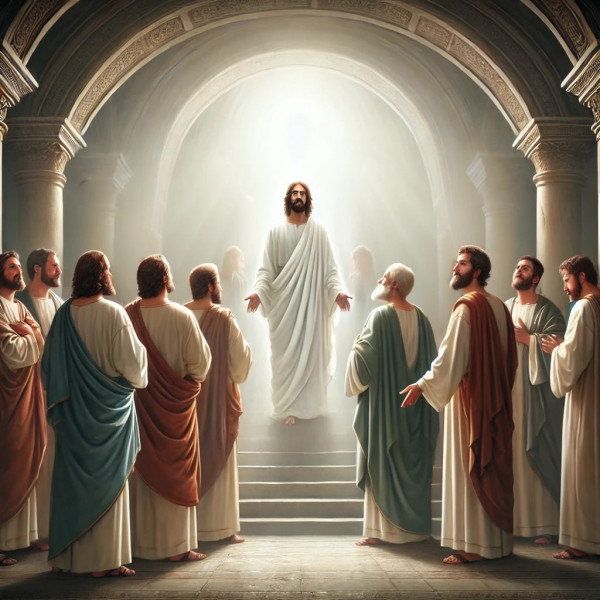
The Power to Forgive Sins: A Gift from Jesus to the Apostles
In John 20:22-23, Jesus grants the apostles the power to forgive sins. By breathing on them, He institutes the sacrament of confession, entrusting the apostles, and later the priests, with the mission of reconciling the faithful with God. This power, also cited in Matthew 16:19, reveals the divine authority to “bind and loose.”
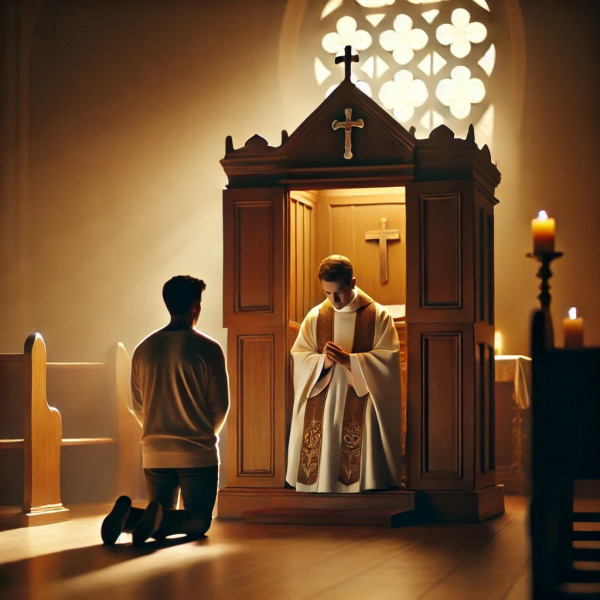
Confession and Reconciliation: The Path to Communion with God
Confession to a priest is a practice recommended in James 5:16, where we are called to confess our sins and seek spiritual healing. As ministers of reconciliation, priests act as mediators of forgiveness, conferring peace and restoring communion with God and the Church, in response to Christ’s call to live in unity with Him.
References
Cited sources
Related questions
Submission note to the Catholic Church
The answers here aim to clarify doubts about the Catholic faith. While every effort is made to ensure conformity with the Church's teachings, we recognize that interpretation errors can occur. If you identify any content at odds with the magisterium, please let us know — we will review and correct promptly.