

Short answer
The Pope is infallible when he teaches ex cathedra in matters of faith and morals.
Full answer
The authority of the Pope, as the supreme leader of the Catholic Church, is founded both in Scripture and the Tradition of the Church. The concept of papal infallibility, as taught in the Catechism of the Catholic Church (CIC 891), states that the Pope is infallible when proclaiming doctrines of faith and morals "ex cathedra," meaning when he speaks in his official capacity as the supreme Pastor of the Church. This infallibility is a gift of the Holy Spirit that ensures that the Pope, in matters essential to salvation, does not err. Since the definition of the dogma of infallibility in 1870, at the First Vatican Council, "ex cathedra" infallibility has been exercised officially twice: in 1854, with the definition of the dogma of the Immaculate Conception of Mary, and in 1950, with the definition of the dogma of the Assumption of Mary.
The biblical basis for this authority traces back to the Gospel of Matthew (Mt 16:18), where Jesus declares to Peter: "You are Peter, and on this rock I will build my Church." This passage highlights Peter's unique role as the foundation of the Church. In John 21:15-17, Jesus entrusts Peter with the mission of tending his sheep, thus affirming his leadership over the Christian community.
At the Council of Jerusalem (Acts 15:7-11), Peter exercises this leadership by deciding that circumcision was not necessary for salvation, demonstrating his authority in teaching the faith. The Pope's authority is also supported by Tradition, as seen in the writings of Saint Ignatius of Antioch, who refers to the Church of Rome as "presiding in love," and Saint Irenaeus of Lyon, who affirms that, due to its "more excellent origin," it is necessary that "the whole Church, that is, the faithful from every place," agree with the Church of Rome, because in it "the tradition coming from the apostles has always been preserved."
Thus, the Pope's authority in matters of faith and morals, and his central role in the Church, is both biblically and traditionally founded, reinforced by the testimony of the early Church and the continuous exercise of this authority throughout the centuries.
Visual aid
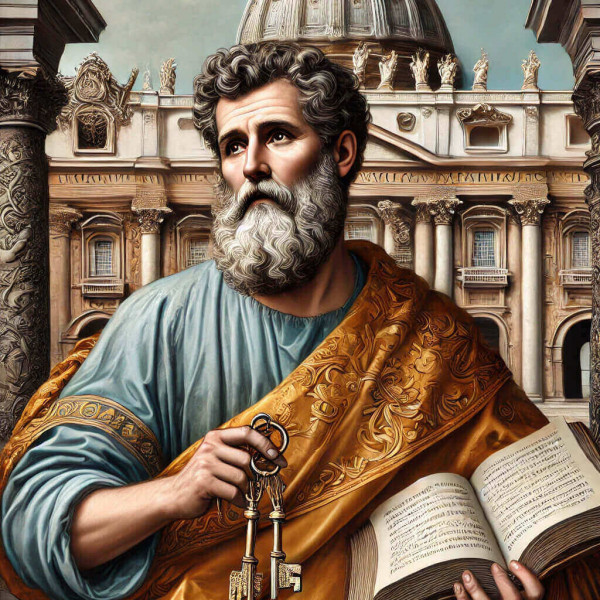
The Authority of the Pope in the Catholic Church
The authority of the Pope as the supreme leader of the Catholic Church is founded in the Bible and Tradition. Papal infallibility, exercised "ex cathedra" in doctrines of faith and morals, is a gift of the Holy Spirit that ensures the preservation of truth in matters essential for salvation, as taught in the Catechism of the Catholic Church.
References
Cited sources
Submission note to the Catholic Church
The answers here aim to clarify doubts about the Catholic faith. While every effort is made to ensure conformity with the Church's teachings, we recognize that interpretation errors can occur. If you identify any content at odds with the magisterium, please let us know — we will review and correct promptly.